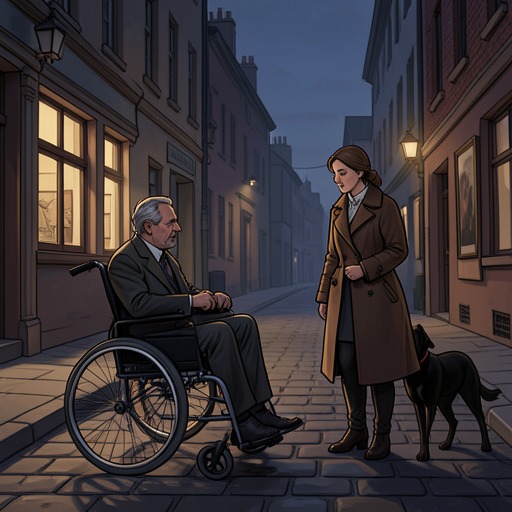
Etienne reveals the attic transmitter
All the Light We Cannot SeeEtienne reveals the attic transmitter to Marie-Laure LeBlanc as a working machine and as the material remainder of a private promise to his dead brother, Henri LeBlanc. The discovery joins the sensory world Marie-Laure navigates by touch to a history of war, paralysis, music, and long-distance communication. Its later return during the siege of Saint-Malo gives this old apparatus a new urgency: what was built to speak to a ghost may still offer a living voice a way out.
The Route to the Attic
Etienne takes Marie-Laure up the stairs to the sixth-floor landing and into the room that once belonged to her grandfather. She already knows its contents by repeated touch: an oar nailed to the wall, curtains at the window, a single bed, a model ship, and a wardrobe too large for her to reach its top or span with her arms. Beside the wardrobe, Etienne opens a small door and invites her to go through. Her fingers find a ladder in the dry, confined space; seven rungs bring her into the attic beneath the roof.
The route is an introduction through physical limits and remembered objects. Marie-Laure cannot survey the room visually, and the attic is not presented to her as a single picture. She learns it through the slope of the roof, the cables underfoot, and Etienne’s hand guiding her past dusty boxes and a sawhorse. He leads her to a piano bench and places her hands on a table. The scene makes the concealed room legible through direction, texture, sound, and scale before explaining its function.
A Machine Heard Before It Is Explained
Metal boxes cover the tabletop: tubes, coils, switches, meters, and at least one gramophone. Etienne settles a headset over Marie-Laure’s ears and turns a crank. A piano begins to play as if located at the center of her head. A staticky voice follows, speaking to children about a piece of coal that was once a plant, perhaps a fern or reed, millions of years earlier; then the piano returns. The attic is not merely a hiding place but a functioning broadcast and recording station, and Marie-Laure encounters it first through its sounds.
When she asks how it works, Etienne identifies the apparatus as a radio transmitter. He guides her hand to the power switch for the microphone and explains the switch for the phonograph, the premodulation amplifier, vacuum tubes, and coils. The antenna telescopes up along the chimney for twelve meters. His account describes a chain of material operations: power, recorded sound or a microphone, electrical components, and an antenna extending above the roof. A voice is not sent by an abstract act of wishing; it depends on parts, connections, and a structure that can carry the signal outward.
Henri’s Voice and the First Purpose
The equipment opens a history that predates the transmitter. Etienne tells Marie-Laure that Henri had been admired for his singing voice, while Etienne himself supplied the technical ingenuity. They dreamed of making and selling recordings. A company in Paris showed interest, and Etienne wrote ten science scripts for Henri to rehearse and record. Daniel LeBlanc, then a boy, used to come and listen. Etienne remembers that period as one of the happiest in his life, joining the brothers’ shared work to the presence of the next generation of the family.
The First World War interrupted that project. Etienne and his father served as signalmen, running telegraph wires from rear command positions to officers at the front. At night, enemy flares called very lights drifted over the trenches on parachutes, exposing the ground to view. Etienne recalls that eighty or ninety could go off in succession; soldiers froze beneath the glare, while the quiet might be broken by a sniper’s bullet. In that setting, Etienne sometimes became so paralyzed that he could not move, even his fingers or eyelids.
Henri stayed beside him and whispered the scripts they had recorded, repeating them through the night as a kind of protection until morning. Henri later died. After the war, Etienne spent years making the transmitter. The Paris recording company was no longer interested, so he played their ten recordings himself, night after night, until most wore out, along with Henri’s song. He says he was not trying to reach England or Paris: he hoped that, if the broadcast were powerful enough, Henri would hear it, find peace, and receive the protection Henri had once given him. The machine’s first audience is therefore an absent brother, not a public one.
A Private Apparatus in a Wider Radio Story
The attic transmitter belongs to a recurring material history of radio in the novel. As a child, Werner Pfennig finds a crude receiver behind a storage shed: a wire-wrapped cylinder between pinewood discs, with frayed electrical leads and an earphone. Its improvised construction gives the discovery an echo of the attic’s more elaborate apparatus. In each case, radio begins with physical components that make otherwise distant voices available, rather than with communication as a disembodied idea.
Later, trapped beneath the ruins of Saint-Malo, Werner makes another rough receiver from salvaged materials. He coils wire around a pipe, uses a diode and battery to complete the circuit, and connects an earphone. Elsewhere, a military radio truck holds listening decks, a folding RF antenna, headsets, maps, and transceivers Werner designed with Dr. Hauptmann. These different uses place radio within childhood curiosity, improvised survival, and military equipment. The attic scene’s intimate origin does not erase the technology’s other functions; it shows how the same medium can carry a family’s memories as well as signals used in wartime.
During the siege, the transmitter again waits on the table beside the chimney, with two marine batteries below it. Marie-Laure crawls to the piano bench and considers who might still have a radio: the fire brigade, the Resistance, the Americans, German forces, or Etienne himself. She cannot know where he is or whether he assumes she is dead, but she imagines that he may need to hear a flicker of hope. She finds the lever by tracing the chimney stones and presses her weight against it; above the roof, the antenna begins to telescope upward with a faint grating noise. The earlier revelation thus becomes a practical possibility in a changed and dangerous present. The machine once built to send a brother’s voice toward the dead may now help a living family member reach someone who may be listening.